Pioneering Professional Growth

Nicole’s lectures aim to provide the highest level of evidence-based science alongside heartfelt and real-world clinical practice experiences for attendees to connect and grow with.  Her lectures are infused with warmth and down-to-earth wisdom alongside collaboration and participant engagement in order to provide useful tools and strategies for on the spot and next day clinical practice application.

Recordings of Nicole’s most recent lectures are accessible for viewing through the American Academy of Physiological Medicine & Dentistry and the Educational Partners Library at Talk Tools.  Please check back for upcoming lecture announcements and feel free to join us as we all grow, connect, and learn together.

Past Lectures

Heart of The Pivot:

Children with daytime airway issues and sleep disordered breathing often present with neurobehavioral sequelae and signs/symptoms of autonomic dysregulation. The far-reaching influence of dysregulation impacts daily function, quality of life, and participation in myofunctional therapy. This lecture introduces a Space & Pace method to improve a child’s self-regulation within a whole-family framework.

The Airway Space & Pace Blueprint

Children with daytime airway issues and sleep related breathing disorders often present with neurobehavioral sequelae and signs and symptoms of autonomic dysregulation that can mimic other conditions such as ADHD, sensory processing differences, and histamine intolerance. In some instances, one or more of these conditions may occur alongside airway issues, and can make obtaining a differential diagnosis challenging. A key feature amongst all these conditions is a child’s struggle to self-regulate. The presence of dysregulation in a child has the potential to undermine their functions across all activities (day and night), decrease quality of life, and impede their ability to participate in myofunctional therapy and other airway-related interventions. By understanding the overlap in presentation of the aforementioned conditions, providers are better equipped to identify other key professionals who are instrumental in an interdisciplinary plan of care, as well as the treatment timing and planning for myofunctional therapy. Given the far-reaching impact of a child’s dysregulation on individual and family function, this lecture will introduce integration of a Space & Pace approach to improve a child’ self-regulation within a whole-child/whole-family framework for optimal outcomes across all interventions.

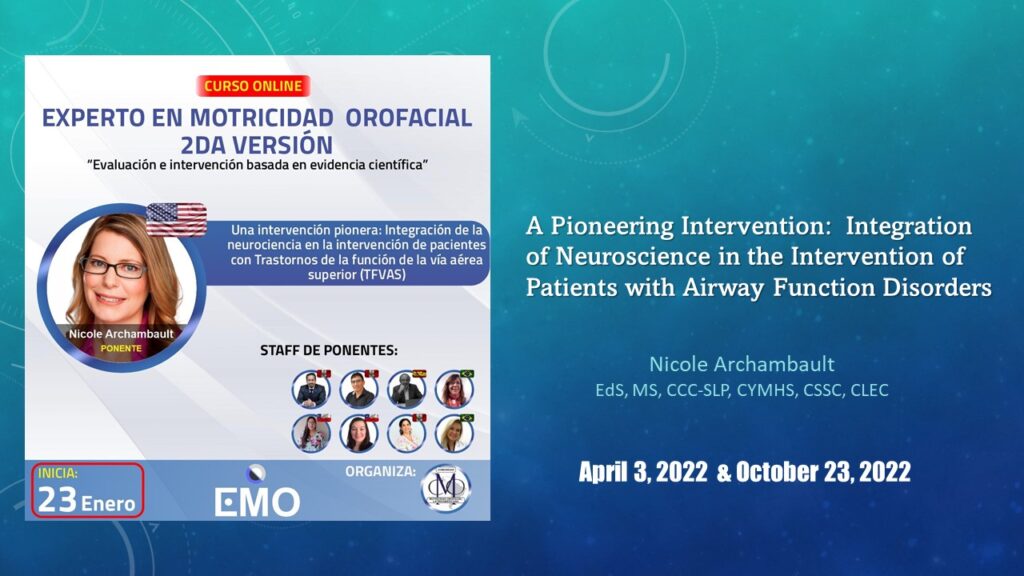
A Pioneering Invervention:

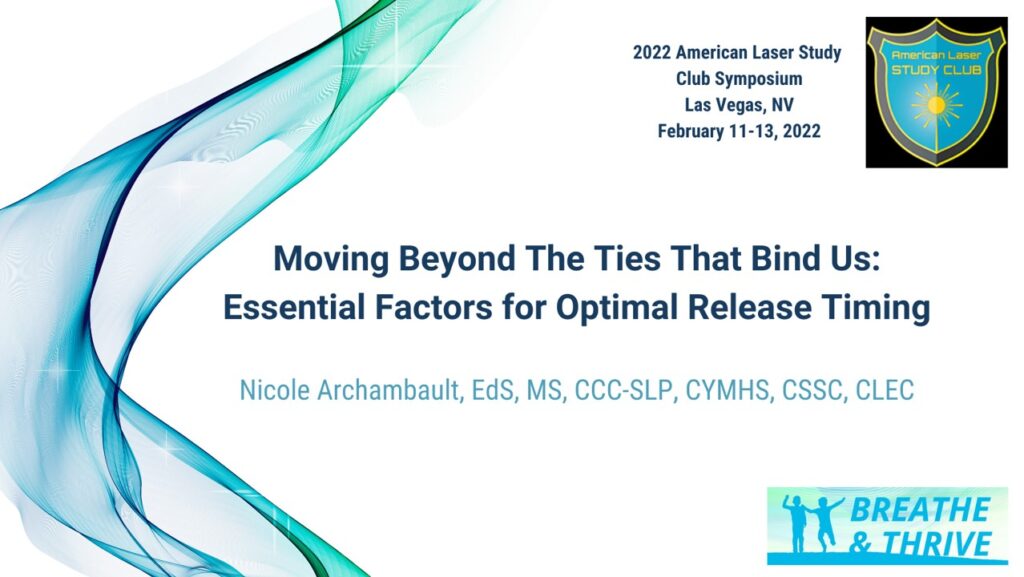
Moving Beyond the Ties that Bind Us

In this lecture, the difference between “needing” a release and being “ready” for release will be illuminated through a whole-child/whole-family dynamic systems approach to care. While many pediatric cases share similar impacts to form and function, this is often where the similarities end, as looking through a larger lens we see that no two cases are exactly alike: no two children, families, or environments will progress along a continuum of care in exactly the same way. With this in mind, it is vital for interdisciplinary teams to step outside the usual lens of form and function to consider other essential factors critical to the timing of optimal release. In this easy to implement approach, neuro-relational, behavioral, and environmental factors will be introduced to help interdisciplinary teams recognize and communicate with families and one another optimal release timing. Red flags within this dynamic systems approach will be introduced, as well as how to explore the state of the autonomic nervous system relative to frenulum release timing in both patients and caregivers. Finally, simple and accessible tools to screen a patient and their family’s readiness for release will be reviewed, as well as how to communicate that information amongst interdisciplinary team members in order to support optimal surgical and therapeutic outcomes.

Watch the lecture

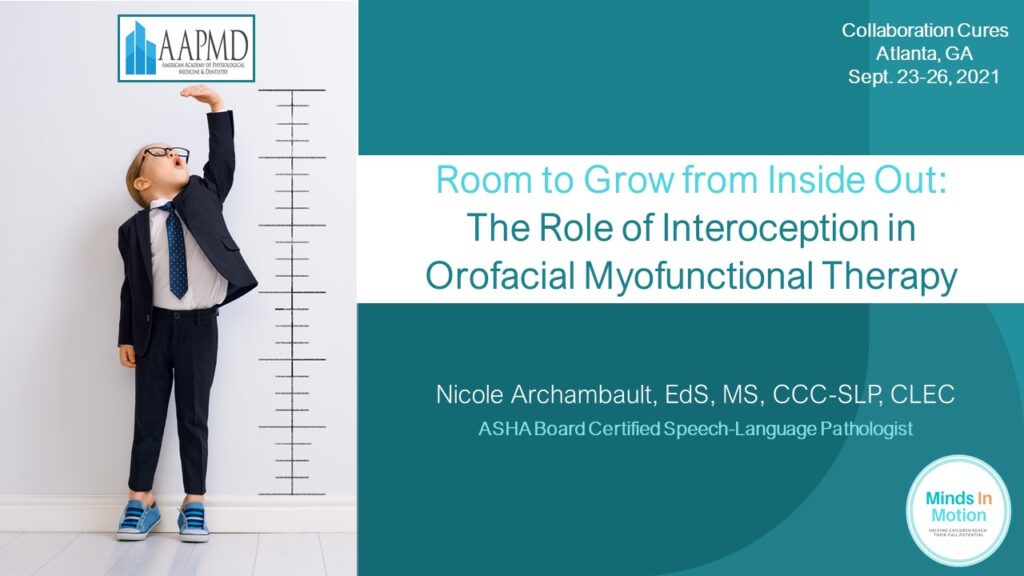
Room to Grow from Inside Out:

Children’s ability to perceive their bodies, feelings, and the connections within, play an integral role in the optimal development of oral functions and nasal breathing patterns. Research across various disciplines has illuminated the emerging role of interoception in human development and function. This session will highlight the latest in research in interoception, as well as innovative ways in which to facilitate interoception within a whole mind-body framework approach to orofacial myofunctional therapy.

Watch the Lecture

Emotional Regulation, Executive Functions, Orofacial Myofunctional Therapy: A Paradigm Shift

Historically, orofacial myofunctional therapy (OMT) programs have focused on the bidirectional relationship between form (structures of the body) and function (ie. nasal breathing, swallowing, chewing, speaking, etc.). Given that many children on OMT caseloads have some type of underlying airway issue and subsequent autonomic nervous system dysfunction, it is paramount that practitioners also consider foundations: the 2E’s (ie. Emotional Regulation and Executive Functions) when looking to implement OMT programs. In other words, we must move children out of their limbic systems and “fight, flight, or freeze” mode and into their prefrontal cortex in order to optimize their ability to access and benefit from our interventions. This lecture is the first of its kind to blend the research from the fields of educational neuroscience, sleep medicine, and applied myofunctional sciences for clinical practice integration to offer interdisciplinary practitioners an additional and important lens from which to screen and treat the needs of children with underlying sleep-related breathing and airway issues.

Watch the lecture

Navigating the World of Autism & Sleep: A Whole Child & Whole Team Approach

As the prevalence of autism spectrum disorder (ASD) continues to rise in children, it is important to note that this special population experiences higher rates of sleep issues than their typically developing peers. In addition to coexisting orofacial myofunctional disorders that can lead to nighttime sleep breathing issues, the presence of other multifactorial causes of sleep problems can pose complex challenges to airway teams tasked with optimizing sleep and overall daytime functions in children with ASD. This presentation will highlight the complexity of neurobiological, behavioral, medical, functional, and environmental challenges in children with ASD, types of sleep issues, and how to effectively serve the needs of the whole child within a whole team approach to airway and sleep management.

Prescription for Play: The Adverse Effects of Lack of Play on Airway and Oral Functions

For children, play is a vital part of growth and development. Research shows that beyond pleasure, the purpose of active play is to provide stimulation for proper perceptual, sensorimotor and neural development, executive and regulatory functions, as well as language, physical and social development. With children’s increasingly sedentary lifestyles and lack of active outdoor play, children’s airway and oral functions are compromised. Through research and case studies, we will bridge the importance of how play can prevent airway and oral dysfunction

Save Lives! Better Chewing Prevents Choking in Children and Adults

According to the US National Safety Council, choking is the 4th leading cause of unintentional death. The UK Office for National Statistics reported that 85% of choking deaths were caused by food and about 91% of all choking deaths were adults over 45 year of age. Otherwise, healthy people still choke on items that require chewing or sticky foods requiring salivation. Through education and appropriate therapy, SLPs can help prevent choking.

Oral Dysfunctions and Sleep Meet Education: A Four-Part Collaborative School-Based Model for Screening

The impact of oral dysfunctions and sleep issues adversely impact children’s learning and academic performance. This session introduces a novel four-part collaborative model for the screening of daytime and nighttime sleep breathing issues in elementary school-aged students.

Schedule a Lecture

Share Nicole’s expertise with your school district or organization.

Contact Nicole

Man’s mind once stretched by new ideas, never regains its original dimensions.

– Oliver Wendall Holmes